
(Video) Watch As This Prepper Uses a Wood Stove As Fuel For A 40 Gallon Hot Water Tank For Off-Grid Living
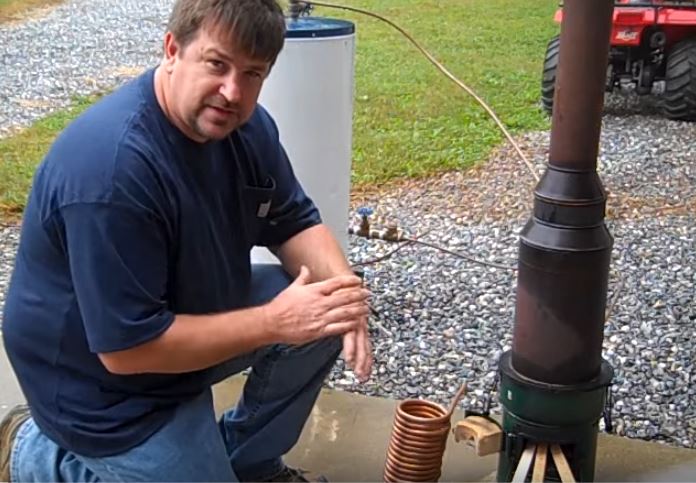
This is the prepper mindset at it’s best. The mindset that refuses to accept defeat and to create a whole new life…
[cmamad id=”3117″ align=”center” tabid=”display-desktop” mobid=”3104″ stg=””]
How the Heater Works
Hence, getting hot water using a wood stove uses the same basic principle as a Hypocaust, but with a twist: water is used in our case instead of air, because it’s difficult to take a shower without water, right? I know – there’s an invention called dry cleaning, but I wouldn’t recommend it.
Joking aside, to keep it simple: a regular water heater is nothing more than a tank of sorts, sitting on top or next to your wooden stove. As water rises when heated, hot water is drawn from the top and cold water is piped at the bottom via a piping system, obviously.
How does it work, you may ask? Well, it’s pretty straightforward: the stove water heater uses heat exchangers for transferring heat from the stove to the water. Depending on the design, the heat exchangers can be mounted inside of the stove, on the outside of the stove, or in the stovepipe.
Water is circulated through the heat exchanger when a fire is burning in two ways: naturally, via the thermosiphon principle which relies on water rising when heated or by using a pump.
The heat exchanger device is available in 3 main varieties:
- a serpentine coil made of, in most cases, copper pipe
- a small absorber, like a solar-collector
- a box-like mini-tank. Most heat exchangers are mini-tanks or coils mounted inside the stove.
The heat exchanger can be built using copper, stainless steel, or galvanized iron, and they’re commercially available or they can be built in local shops or DIY-ed depending on your skills. For our intents and purposes, we’ll have to rely on the thermosiphon system, because this system works wonderfully off the grid and it doesn’t require fancy stuff like pumps and all that jazz.
The Tips that Lead to Success
“Keep it simple stupid” is the name of the game in a survival situation. As things get complicated, the probability of something failing rises exponentially.
Whenever the stove is used, water must circulate through the heat exchanger in order to prevent it from boiling. The storage tank must always be located higher than the heat exchanger and as close as possible to the stove.
Thermosiphoning-based systems are better than electrical-pumped ones not only because of their simplicity and availability, but also because in the eventuality of a power outage, the pump will stop working, leading to overheating the water in the heat exchanger.
So, now you’ve got one more amazing use for a wood stove! For more great survival tips and tutorials, please visit Survivopedia.
Please SHARE this with your family and friends – thanks
