
Cure Your GPS Addiction – Navigate The Old Fashioned Way By Using The Sun And Stars!
[cmamad id=”3086″ align=”center” tabid=”ad-off” mobid=”3104″ stg=””]
The sun and stars will still be in the sky when GPS fails after SHTF! So learn how to make use of them to find your way around, or even to simply tell the time without a watch…
1. Finding Direction by Day
via:FM 21-76
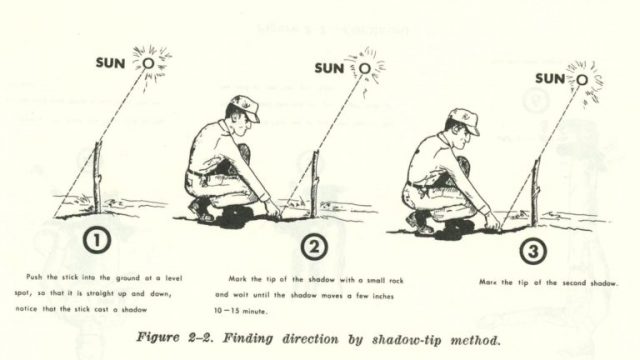
(a) Steps to follow. Find a fairly straight stick about 1 meter long and follow these steps:
Step 1: Push the stick into the ground at a fairly level, brush-free spot where a distinct shadow will be cast. The stick need not be vertical; inclining to obtain a more convenient shadow, in size or direction, does not impair the accuracy of the shadow-tip method.
Step 2: Mark the shadow tip with a small peg, stick, stone, twig, your finger, hole in the snow, or other means. Wait until the shadow tip moves a few inches — using a 1 meter stick, 10 to 15 minutes should be sufficient.
Step 3: Mark the new position of the shadow tip.
Step 4: Draw a straight line from the first rock to the second rock and extend it about a foot past the second rock.
Step 5: Stand with the toe of the left foot at the first rock and the toe of the right at the end of the line you drew.
2. Finding Direction at Night
via: FM 21-76
Direction can be determined by means other than a compass:
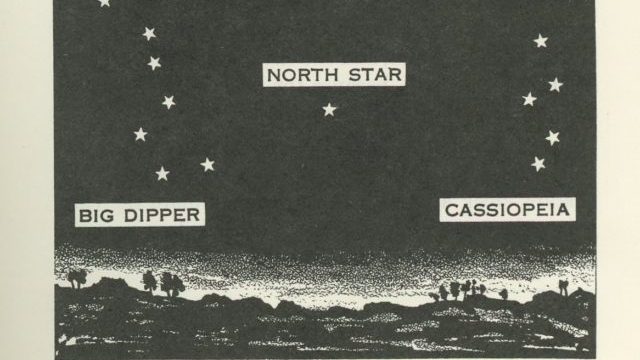
(1) To find the North Star, look for the Big Dipper. The two stars at the end of the bowl are called the “pointers.” In a straight line out from the “pointers” is the North Star (at about five times the points). The Big Dipper rotates slowly around the North Star and does not always appear in the same position (fig. 2-4). The constellation Cassiopeia can also be used. This group of five bright stars is shaped like a lopsided M (or W, when it is low in the sky). The North Star is straight out from the Big Dipper. Cassiopeia also rotates slowly around the North Star and is always almost directly opposite the Big Dipper. Its position, opposite the Big Dipper, makes it a valuable aid when the Big Dipper is low in the sky, possibly out of sight because of vegetation or high terrain features.
3. Determining Time
via: FM 21-76
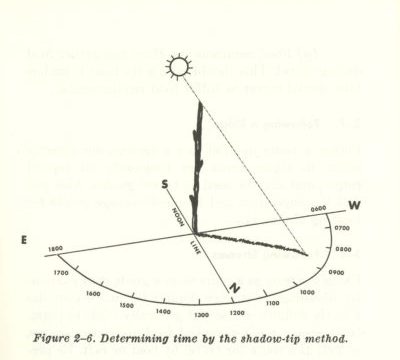
(1) Move the stick to the intersection of the east-west line and the north-south line, and set it vertically in the ground. The west part of the line indicates 0600 hours, and the east part is 1800, ANYWHERE on earth, because the basic rule, described in 1c in “Finding Direction by Day” above always applies.
(2) The north-south line now becomes the noon line. The shadow of the stick is an hour hand in the shadow-clock and with it you can estimate the time using the noon line and the 6 o’clock line as your guides (fig. 2-6). Depending on your location and the season, the shadow may move either clockwise or counterclockwise, but this does not alter your manner of reading the shadow-clock.
It takes a bit of practice, but once you have the hang of it then you’ll have a very useful skill tucked away in your back pocket. So don’t wait and get some training in now!
For more on this, be sure to visit Art of Manliness.
Please SHARE this with your family and friends – thanks
